“Sometimes when you’re in a dark place you think you’ve been buried, but you’ve actually been planted.”
#MondayMotivation

TAGB Tae Kwon-Do Schools in Emersons Green and Chipping Sodbury, South Gloucestershire, Bristol

“Sometimes when you’re in a dark place you think you’ve been buried, but you’ve actually been planted.”
#MondayMotivation
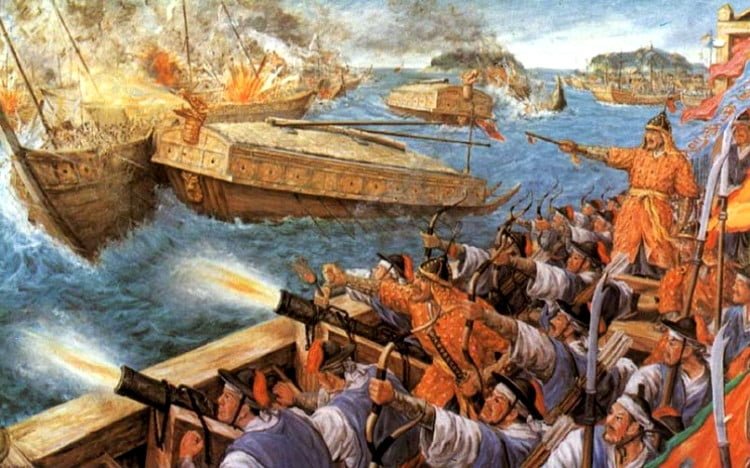
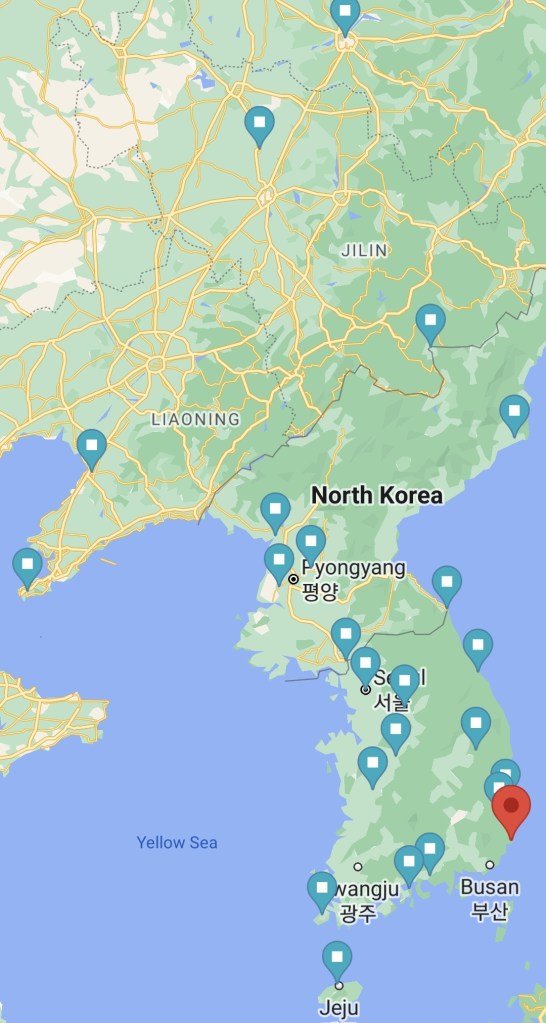
85 miles later and we arrive in Sachon Bay to celebrate the final battle of Yi Soon-Sin.
Yi Soon-Sin was born on 28th April 1545 in Hanseong. From a young age he was proficient in reading and writing Chinese and making bows and arrows. At 31 he took his military exam, where he impressed the judges with his swordsmanship and archery skills but unfortunately failed when he broke his leg during the cavalry assessment. Once healed he retook the exam and passed, after which he was posted to Bukbyeong (Northern Frontier Army) where he defended the border villages against the Jurchen People, capturing and executing their Chief, Mu Pai Na, in 1589.
After taking 3 years out to mourn his father’s death he returned to fight the Jurchen and led many successful campaigns. With all this success his seniors became jealous and, led by General Yi Il, falsely accused him of desertion. Yi Soon-Sin was stripped of his rank, imprisoned and tortured. Eventually he was released and allowed to work his way back up the ranks again. It wasn’t long before he was appointed Commander of the Seoul Hunryeonwon, then Commander of the Kosarijin Garrison, Commander of the Manpo Garrison, Commander of the Wando Garrison, and finally Commander of the Left Jeolla Naval District, where he was able to build up the navy through a series of reforms.
In 1592, Hideyoshi Toyotomi ordered Japan to invade Korea with the objective of using it as a base to invade the Ming Dynasty of China, and prepared a fleet of 1,700 ships. Yi Soon-Sin had never commanded a navy before but engaged the Japanese fleet at Goeja Island in the Battle of Okpo, the fist battle of the Imjin War. Following Yi’s victory he was promoted to the rank of Commander of the Three Provinces by King Seonjo. We learnt in our visit to the Kobukson at the War Memorial of Korea how Yi Soon-Sin used this armoured battleship to strike fear and panic into the Japanese and defeated them at the Battle of Sacheon. Later that same year, Yi Soon-Sin was involved in the Battle of Hansan Island. The Japanese had realised that they were losing control of the seas and with that their supplies to troops were under threat, so Hideyoshi Toyotomi ordered Commander Yasuharu Wakizaka to combine with two other Japanese fleets to hunt down and destroy the Korean fleet. But Wakizaka was an impatient man with some of the best ships of the time, so he set out alone with his 73 ships to face Admiral Yi Soon-Sin.
Whilst Wakizaka’s fleet were anchored near the narrow channel of Gyeonnaeryang Strait, Yi Soon-Sin sent in six ships to lure them out. Wakizaka took the bait and gave chase, pressing forwards even when he exited the channel and discovered the rest of the Korean fleet were waiting for them. Yi had been working on a “crane wing” formation with his ships, a common tactic in land battles to surround the enemy. Wakizaka, known for his aggressive tactics, pushed forward into the circle of Korean ships with the intention to get as close as possible and board them, but Yi’s long range firepower helped prevent them from getting too close.
The battle continued for around 6 hours before Wakizaka abandoned his flag ship and escaped on a faster vessel. Out of his 73 ships only 14 escaped the Koreans, and most of these were so badly damaged they were abandoned before they got back to Busan Harbour.
Yi Soon-Sin’s victory at the Battle of Hansan Island is considered the most important of the Imjin War because of its impact on supplies to troops, slowing the land advance so much that the Japanese got no further than Pyongyang and never really made it to their original destination of China.
It was following this victory that Yi Soon-Sin pressed forwards to attack the Japanese at their own base of Busan Harbour, sinking 115 Japanese ships before withdrawing because of a lack of land forces to continue the battle.
In 1597, a Japanese agent befriended the Korean General Kim Gyeong-Seo and convinced him he would spy on Japanese operations for him. He later told him Japanese General Kato Kiyomasa would soon arrive with a great fleet and that Yi Soon-Sin should be sent to ambush them. The news was relayed to King Seonjo who agreed to send Yi Soon-Sin, but Yi refused as he knew the area to be full of hidden, sunken rocks and he didn’t trust the information given by the spy. When the King was informed of Yi’s refusal his enemies at the court insisted he be replaced by General Won Gyun. Yet again Yi was relieved of command, arrested and tortured. King Seonjo was so convinced of Yi’s treachery that he wanted him executed, but Minister Jeong Tak and others that supported him convinced the King to spare him due to his military record.
Again, Yi Soon-Sin was released and demoted to a mere infantry soldier under General Gwon Yul, but Yi took this with humility. Meanwhile Won Gyun, Yi’s replacement, failed to respond quickly enough to reports and allowed 1,000 ships to land 140,000 Japanese reinforcements which thankfully the Chinese reinforcements were able to push back. In 1597, Won Gyun took the entire Joseon Navy that Yi had built up to attack the Japanese in the Battle of Chilchonryang. The Battle was poorly planned; Won Gyun failed to prevent the Japanese from boarding their ships. All but 12 of the 150 warships were destroyed. Won Gyun along with a few survivors escaped to a nearby island but soldiers from a nearby Japanese fort managed to capture and execute Won Gyun.
Upon hearing the news, King Seonjo quickly reinstated Yi Soon-Sin to his former post. What happened next was the most famous battle of Yi Soon-Sin’s career, but we will learn about that at a later stop. The Korean Navy were now back in charge of the Yellow Sea, the main supply route to Korea, and Japan had begun a full retreat. The people of Korea were celebrating Yi’s victory but the Japanese had secretly sent 50 soldiers to Yi Soon-Sin’s home village in Asan. Many houses were burned as they searched for Yi’s family. Most had escaped to the mountains but Yi’s 21 year old son Yi Myon-Shin remained; he managed to kill 3 Japanese soldiers before being killed himself. Hearing of the death of his son, Yi sought the privacy of a friend’s house to weep.
On 15th December 1598 a massive Japanese fleet gathered in Sachon Bay to break an allied blockade of one of their fleets and sail safely back to Japan. Yi gathered his fleet of 85 ships along with the allied Ming fleet of 65 ships led by Chen Lin and headed to meet the Japanese. The Battle of Noryang began at 2am on the 16th December. As per previous battles, Yi’s tactics were extremely effective and the Japanese were soon in full retreat. As they pursued the Japanese, a stray bullet hit Yi’s left armpit, and he immediately knew it was fatal. He famously ordered his nephew Yi Wan to impersonate him so as not to demoralise his men, saying “The war is at its height, wear my armour and beat my war drums. Do not announce my death” dying moments later.
Throughout his career he maintained the respect of his troops and many of his superiors. He treated everyone with respect and was considered a brave and charismatic leader who fought alongside his troops. Sadly, King Seonjo’s view was manipulated so much during his reign that he was said to have shown no signs of grief at the news, and the Joseon Dynasty didn’t continue with any of Yi’s reforms with the Joseon Navy and Kobukson disappearing into history. Yi Soon-Sin’s legacy lives on however with over 200 of his direct descendants pursuing military careers. Yi was posthumously awarded the title Chungmugong meaning Duke of Loyalty and Warfare. He is revered throughout Korea and is considered one of its greatest heroes.
We will be marking our arrival here with 85 leg crossovers before continuing 23 miles west to visit an army.

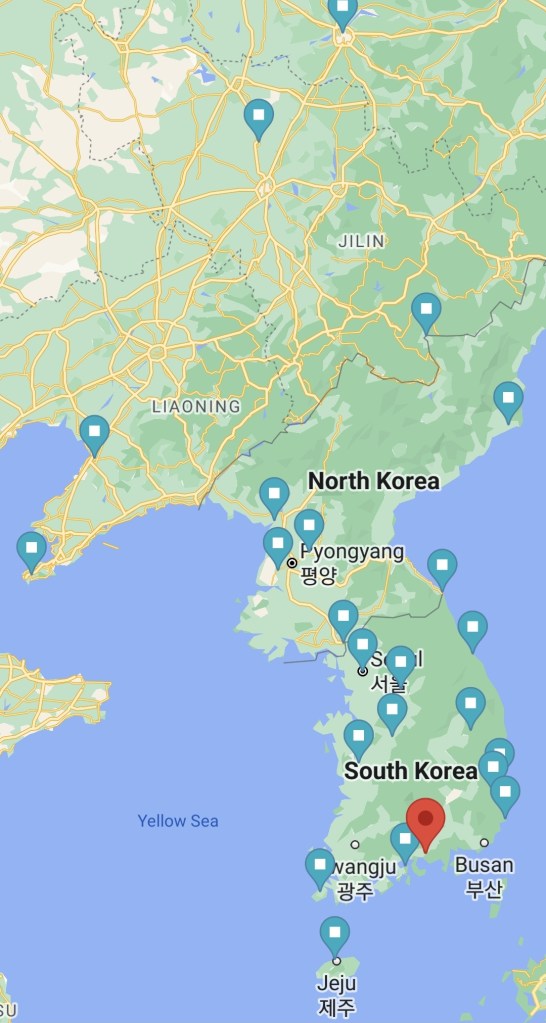
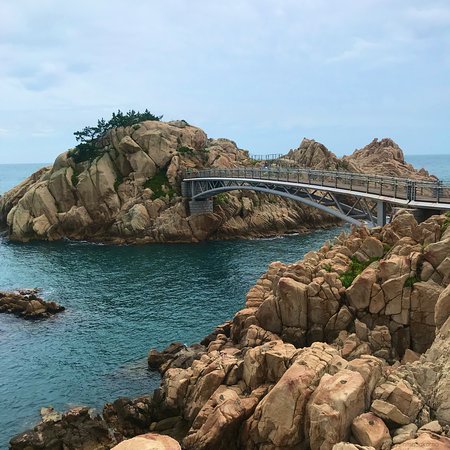
26 miles later and we arrive in Daewangam Park, the burial place of Moon Moo.
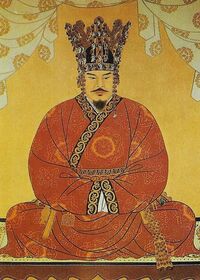
Prince Kim Beom-Min (Moon Moo) was born in 626 AD the son of King Muyeol and Queen Mun-Myeong (the sister of Kim Yoo Sin). During King Muyeol’s reign, Prince Kim Beom-Min was responsible for Silla’s navy. We learnt at Nonsan-Si how it was King Muyeol’s friendship with Tang Emperor Gaozong which brought the Chinese to the aid of the Silla Dynasty at the Battle of Hwangsanbul. King Muyeol died shortly after the battle of Hwangsanbul, in 661 AD, and Prince Kim Beom-Min took the throne, taking the name King Moon Moo.
King Moon Moo continued with his father’s plans to defeat Goguryo and attacked it the same year, but was unsuccessful. He tried again in 667 AD, and a year later finally succeeded, making him the first King of “Unified Korea”.
Although allied with Silla, the Tang were keen to control Korea, and placed a protectorate general’s office in Silla territory with General Xue Li. King Moon Moo resisted their attempts and the alliance fell apart. By 674 AD they were frequently battling, as Moon Moo tried to defend the new Unified Korea. Moon Moo then sought the help of a resistance group in Goguryo led by Geom Mojam and An-Seung (believed to be an illegitimate son of Goguryo’s last King). Moon Moo gifted An-Seung land to rule as “King of Bodeok” and told him to gather his former people to live as brothers to Silla. However, the territory wasn’t in Goguryo but former Baekje, and was set up as a deliberate buffer between Silla and the Tang.
Emperor Gaozong grew frustrated at Moon Moo’s resistance, and proclaimed his brother Kim In-Mum as the true King of Silla. King In-Mum had worked for Emperor Gaozong at the request of his father King Muyeol for 23 years. He marched on Silla with a Tang Army, ready to claim the throne, when Moon Moo apologised to Emperor Gaozong. The apology was accepted and the Tang forces recalled, but peace didn’t last long. In 676 AD Tang sent General Xue Li across the sea with a naval fleet to invade Silla. Moon Moo defeated the Tang fleet and upon General Xue Li’s return home he was stripped of his rank and exiled by Emperor Gaozong, who then ordered all Tang forces withdraw from Silla, moving the protectorate general’s office to China.
Eventually, following a revolt against the Tang Empire by Eastern Turks, Emperor Gaozong renounced all claim to Unified Korea to focus on problems at home. This would be the last time China would invade Korea.
In 681 AD King Moon Moo sadly fell very ill. On his deathbed he abdicated his throne to his son saying “A country should not be without a King at any time. Let the Prince have my crown before he has my coffin. Cremate my remains and scatter the ashes in the sea where the whales live. I will become a dragon and thwart foreign invasion.” As per his wishes, his ashes were indeed scattered into the sea here at Daewangam (the Rock of the Great King), about 100 metres off the coast. His son, King Sin-Moo built Temple Gomun-sa in memory of his father, which he connected to the sea by a waterway so that the sea dragon could visit. It is said that King Sin-Moo had a dream in which Moon Moo and Kim Yoo-Sin appeared and told him “blowing on a bamboo flute will calm the heavens and the earth.” Upon visiting the sea, Sin-Moo found a flute and blew it, invoking their spirits so that they could defend the nation and control the rains.
We will be marking our arrival here with 26 spinning outward crescent kicks before continuing 85 miles south west to a famous battle site.

“When it rains look for rainbows. When it’s dark look for stars.”
#MondayMotivation





“Believe in yourself and you will be upstoppable”
#MondayMotivation

“Don’t let small minds tell you your dreams are too big”
#MondayMotivation






 Newman Martial Arts