Tour Through Time: Stop 16: Shinsa-Dong

After crossing the Han River we arrive in the Do San Memorial Park in Shinsa-Dong, Seoul. It was built in 1973 to mark the 95th anniversary of Ahn Chang-Ho’s birth. His body was exhumed from the Manuri Cemetery in Seoul and reburied in the park alongside his wife, Lee Hae-Ryon.

Ahn was born on Torong Island on 9th November 1878 (not 1876 as most sources quote). He was born into a farming family and converted to Christianity as a teenager. In his early 20’s he established Cheomjin, the first co-educational elementary school in Korea. At 24 he emigrated to America with his wife with the aim of achieving a western education which would enable him to help further the education of Koreans. It is said that as he saw the volcanic peaks in Hawaii he decided to call himself Do San (Island Mountain), resolving to “stand tall above the sea of turmoil existing in Korea at that time”. However, upon arriving he was shocked at the lack of unity between Korean Americans so instead focussed his efforts on creating enlightenment and unity between them. He had a very hands-on approach, travelling from house to house helping with household chores, planting flowers, cleaning windows and even cleaning toilets.

In Riverside, California he noticed that just like in his homeland, Japanese labour contractors controlled the jobs and excluded the Koreans, so Ahn convinced orchard owner Cornelius Earle Rumsey to loan him $1,500 to set up a Korean employment agency. Ahn was able to repay Cornelius within a month which impressed him so much that Cornelius decided he would only ever employ Koreans. Both then worked to provide affordable housing for Cornelius’ employees, leading to the first Korean village in California.

After founding the Korean National Association in America he returned to Korea and formed an independence group known as the Shinmin-Hoe (New People’s Association) which promoted Korean independence via the cultivation of nationalism in education, culture and business. By 1910 it had grown so large that it attracted the attention of the Japanese, who fabricated a fake plot to assassinate Governor-General Masatake Terauchi and used this to arrest the Shinmin-Hoe leaders and 600 innocent Christians. 105 Koreans were tried after horrific torture during which many of those arrested died. These events drew the attention of the worldwide community and international pressure was placed on the Japanese who eventually allowed most to go free.

After the assassination of Hiro-Bumi Ito Japan tightened its grip on Korea’s leaders and Ahn was forced into exile in Manchuria before returning to America. In 1911 Japan passed the Education Act, forcing all Korean schools to close. Meanwhile in America Ahn was elected chairman of the Korean National People’s Association which negotiated with the United States Government, and formed the Hungsadan, a secret association of patriots whose goal was to “lay the groundwork for the great undertaking of enlightening the people of Korea. It was the Hungsadan that helped put pressure on American President Woodrow Wilson to speak on behalf of Korean autonomy at the Paris Peace Conference. After the Sam-Il demonstrations took place Ahn travelled to Shanghai to help form part of a Provisional Korean Government and help draw up a Democratic Constitution for Korea along with future South Korean President Syngman Rhee. In 1932 he and other independence activists were arrested following bombings by Korean patriot Yoon Bong-Gil and was shipped back to Korea. He was sentenced to 4 years in prison but was paroled after 2 years. Due to continuing political unrest he was arrested again in 1937 and despite his age was tortured until he was released on bail to Kyungsung University Hospital in Seoul, suffering from severe tuberculosis, pleurisy and peritonitis. Here he sadly passed away on 10th March 1938.

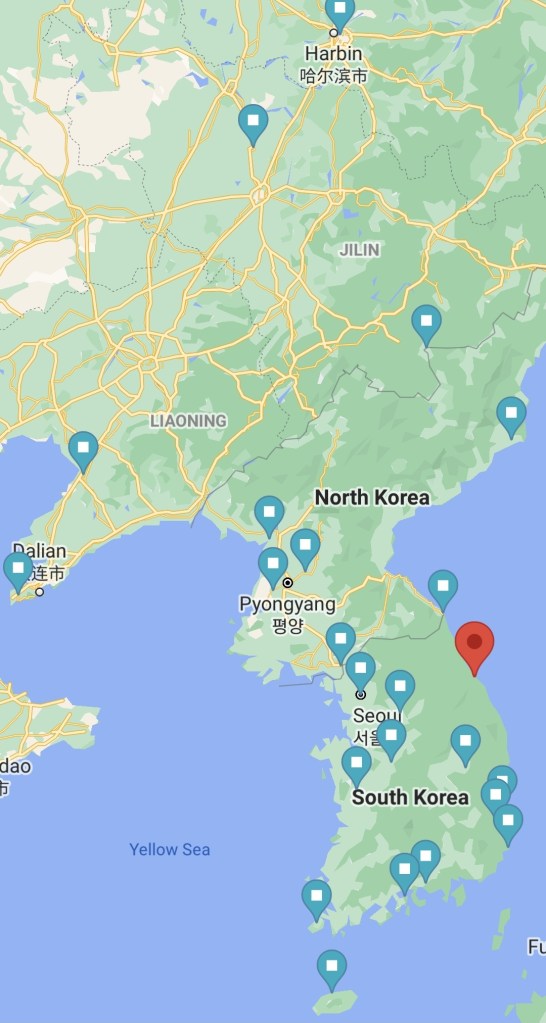
We will be marking our arrival here with a 2 minute plank before continuing 37 miles south east to the tomb of a great King.

Tour Through Time: Stop 15: War Memorial of Korea

A short 1 mile later and we arrive at a military museum known as the War Memorial of Korea. It was opened in 1994 on the site of army headquarters for the purpose of preventing war, exhibiting a vast array of memorabilia from Korea’s long military history.

One item on display is a full-sized replica of the famous Kobukson (turtle ship). It is commonly believed to be invented by Admiral Yi Soon-Sin, but he didn’t actually invent it, he merely improved on an earlier design. In 1592, after Yi Soon-Sin had been promoted to Commander of the Three Provinces by King Seonjo following the successful Battle of Okpo, Admiral Yi received reports from Admiral Won Gyun that Japanese ships had been sighted at Sacheon and sailed to meet them in would be his second battle. After surveying the area and spotting 12 large Japanese battleships near a cliff top where soldiers could shoot his ships from above he decided to instead lure the Japanese out to sea. The quick retreat by Yi Soon-Sin indeed caused the Japanese Commander to order part of his fleet to pursue. The Japanese began to catch up with them as the light began to fade, only for Admiral Yi to turn his fleet around, unleashing a hail of cannon balls and fire arrows which inflicted heavy damage on the Japanese. The Kobukson was a battleship with an iron spiked roof, a dragon head containing four canons at the front, and a further 26 canons spread all round the ship on all sides. It was a formidable ship that struck fear into the Japanese as it sailed through their fleet. Admiral Yi later wrote to King SeonjoIn this battle, the turtle ships carried out dramatically their mission as the vanguards when I faced the enemies. They were really successful”.

Another item found at the military museum is an exact replica of the Kwang-Gae-Toh Stele. The original Kwang-Gae-Toh Stele was built in 414AD by Kwang-Gae’s son, King Jangsu, and was discovered in 1875 by a Chinese Scholar in Manchuria. A stele is a tall stone slab erected for commemorative purposes, and is often inscribed with the names and a list of their deeds. This particular stele was inscribed with details of the reign of King Kwang-Gae, including a badly scratched passage which seems to imply that Japan conquered Baekje and Silla in 391AD, an implausible claim with no historical records to support it. This passage has been dismissed by Korean Scholars who believe it was intentionally defaced by the Imperial Japanese Army to give precedent for their occupation of Korea in the 20th century. King Kwang-Gae Toh Wang (a posthumous title roughly meaning “Very Greatest King, Broad Expander of Territory”) accomplished a great deal for the Kingdom of Goguryo in his 22 year reign, gaining a great deal of territory for Goguryo and making it a major power within the Three Kingdoms. He was one of only two Kings to have ever been given the addition title “the Great”; the other was King Se-Jong the Great of the Joseon Dynasty who invented the Korean alphabet.

We will be celebrating our arrival at the museum with a 1 minute wall sit, before continuing 2 miles east across the Han River to a memorial park in Seoul.

Tour Through Time: Stop 14: Taehwagwan Restaurant

We have now reached the Taehwagwan Restaurant in Seoul, but we aren’t here for the food! We are here to remember an event which happened here back in 1919.

Koreans were fed up of the oppressive Japanese occupying their country and treating them like 3rd class citizens following the annexation of Korea in 1910. The suspicious death and suspected poisoning of Emperor Gojong on 21st January 1919 became the catalyst for Korean’s demanding their freedom. Korean media ran a series of articles based on American President Woodrow Wilson’s speech on The Fourteen Points at the Paris Peace Conference, where he spoke of the right of nations to self-determination.

In the Taehwagwan Restaurant at 2pm on 1st March 1919 the Korean Declaration of Independence as written by Korean historian Choe Nam-Seon was read out and signed by the 33 patriots. A copy was sent on to the 2nd Governor-General of Korea Yoshimichi Hasegawa.

“We herewith proclaim the independence of Korea and the liberty of the Korean people. This we proclaim to all the nations of the world in witness of human equality. This we proclaim to our descendants so that they may enjoy in perpetuity their inherent right to nationhood. In as much as this proclamation originates from our five-thousand-year history, in as much as it springs from the loyalty of twenty million people, in as much as it affirms our yearning for the advancement of everlasting liberty, in as much as it expresses our desire to take part in the global reform rooted in human conscience, it is the solemn will of heaven, the great tide of our age, and a just act necessary for the co-existence of all human-kind. Therefore, no power in this world can obstruct or suppress it!”

At the same time, student Chung Jae-Yong read the declaration to the crowds gathered in Pagoda Park, and other appointed delegates read it aloud to crowds of Koreans all over the country.

They movement leaders telephoned the central police station to inform them of their actions and were promptly arrested. Meanwhile, more than 1,500 protests, marches and demonstrations formed all over the country with approximately 2 million Koreans taking part. Japanese police could not suppress the non-violent protests and the army and navy were called in to assist. They fired into unarmed crowds and shocking stories of beatings, stabbings, beheadings and even crucifixions were reported back by American missionaries in Korea. In one village the entire population were herded into a locked church and which they burnt to the ground, shooting through the windows to prevent anyone escaping. Over 7,500 Koreans were killed by the Japanese, with a further 17,000 wounded and over 47,000 arrested. Many of those arrested were taking to the infamous Seodaemun Prison where they were tortured and many put to death at the “death house” without trial.

Korea was sadly not to gain its independence from the Japanese until 1945, but the Sam-Il movement of 1st March 1919 still resulted in some big changes for the Korean people. The Governor-General was replaced, the military police force was exchanged for a civilian police force, and some of the most objectionably rules imposed by the Japanese were lifted. As noted in our visit to Cho Man-Sik’s birthplace of Kangso-Kun, the peaceful resistance of the Sam-Il movement went on to inspire Mahatma Ghandi’s own non-violent resistance movement in India, and in 1949 the 1st March was designated a public holiday in Korea.

We will be marking our arrival here with 11 cossack squats before continuing 1 mile south to a museum.

Tour Through Time: Stop 13: Goyang-Si

Well, we overshot that… a lot! We arrived in Goyang-Si about 50 miles ago and have had a lovely long run around the city! Goyang is situated in Northern South Korea and is one of the satellite cities of Seoul with a population of over 1 million.

We are here to visit the tomb of General Choi-Yong, who was born in 1316, the son of a government official. He lived his life by the motto his father gave him “look at gold as if it were stone” and always lived a simple lifestyle despite his wealth. He was a strong young man who diligently studied martial arts and military strategies. He inevitably moved quickly up the ranks of the Korean Army, famously fighting off Japanese pirates from the Korean coastline in 1350. Just two years later he helped crush a rebellion by Jo Il-Shin; and in another 3 years a second rebellion by a group known as the Red Turbans. Choi-Yong was at this point a national hero and very popular with King Gong-Min.

Later a rebellion in the Yuan Dynasty of China spilled into Goryeo Dynasty, and General Choi-Yong along with General Yi Seong-Gye were sent to help the Yuan forces as well as reclaim the areas of Goryeo which had been overrun by rebels. Following his victories here Choi-Yong reported back to King Gong-Min on the weakened state of the Yuan Dynasty. The King decided that now would be a good time to reclaim some of the northern territories Goryeo had lost to the Mongols, and dispatched General Choi-Yong who was successful in reclaiming many of the territories on the Korean side of the Yalu river. After becoming Mayor of Pyongyang, increasing crop production and ending a famine he returned to the military when court official Kim Yon-An tried and failed to overthrow the Goryeo Government with a Mongol force of over 10,000.

A Buddhist monk named Shin-Don was promoted to a high position in the Court by King Gong-Min. After having a dream in which a Buddhist monk saved his life, Choi-Yong thought the dream was coming true. The monk became a personal advisor to the King and worked hard to improve the lives of Goryeo peasants; but the power soon went to his head and he became corrupt. Choi-Yong joined many officials who vocally opposed him but Shin-Don engineered false allegations of misconduct against Choi-Yong and had him exiled. Choi-Yong was only able to return 6 years later when the King finally saw Shin-Don’s corruption and had him executed, restoring Choi-Yong’s position. Choi-Yong was tasked with driving Mongol forces from Goryeo owned Jeju island, but whilst he was winning here, Japanese pirates had managed to take the Goryeo city of Gongju. After being introduced to gun powder weapons by scientist Choe Mu-Seon, Choi-Yong returned and easily defeated the pirates.

Meanwhile, the Ming Dynasty had replaced the Yuan Dynasty of China and in 1388 sent an envoy to Goryeo to demand the territories previously taken were returned. As we discussed on our last stop at Sonjuk Bridge, Choi-Yong convinced the King to send Yi Seong-Gye and his troops to attack the Ming, only for Yi Seong-Gye to turn around and return to capital, storm the palace, de-throne the King and banish Choi-Yong to Goyang. He executed him by beheading a short while later in 1388. Choi-Yong is famously known to have said that grass would never grow on his grave due his unjust end, and in over 600 years since his death it never did.

Opinions of General Choi-Yong are as varied as they are General Yi Seong-Gye; both viewed by some as great devoted Generals, others as usurpers to the throne. His loyalty to the Kings may have varied but his loyalty to Goryeo never once wavered.

We will be marking our arrival here with 27 V Ups before continuing 11 miles south to a restaurant in Seoul.